

Admiration and Provocation in Equal Measure
Making UK Garage from California

A San Francisco–founded record label releasing a UK Garage compilation is, on its face, a somewhat absurd proposition, and we knew this going in. The premise invites a particular set of obvious questions — about ownership, about authenticity, about who has the standing to claim what — and rather than try to deflect any of them, UK Garage from California was built to sit inside them on purpose. Half sincere love letter to the transatlantic exchange that has shaped almost everything good about dance music for the last forty years, half a knowing nod to the territorial seriousness that both sides of that exchange occasionally indulge in, the project is a deliberate piece of provocation dressed up as homage, or homage with provocation tucked inside it, depending on which way you tilt it. Holding these multitudes without letting it collapse into either pure reverence or pure irony turned out to be most of the design problem, and most of what this piece is about.
It’s been a minute since the record came out, and the delay is part of what we want to talk about. There’s a version of this piece that would have arrived alongside the release — a timely, energetic, here-is-our-new-record version that the marketing logic of releases tends to demand — but that piece felt less interesting than the one we can write now, because in the months since the compilation came out a few things have settled that weren’t settled at the time, and the artwork has done some work out in the world that we didn’t fully predict, and the conversation it was trying to enter has shifted in ways that change what the project actually means. The current UKG wave, which felt like a wave when we started, mostly doesn’t feel like a wave anymore. It’s just where a large number of producers live now, on both sides of the Atlantic, and the questions about ownership that animated the project at conception have softened into something more like the texture of a settled fact, which is, for me, a better place to write from than the moment of release would have been.
The Genealogy Was Always Promiscuous
To go over briefly what most people who care already know: the word garage, as a genre marker, traces back to New York’s Paradise Garage, the SoHo club where Larry Levan held residency through the late seventies and early eighties, and whose distinctly soulful, vocal-led take on dance came to be known simply as garage music. Records from that scene crossed the Atlantic, British DJs sped them up from about 120bpm to 130ish to better lock into the energy of the jungle and hardcore that was already running UK clubs, and what came out the other side was unmistakably British — choppy drum programming, pitched-up vocal cuts, MC traditions descended from Jamaican sound system culture braided together with pirate radio, all of it operating in a register that the American originators would have recognized as related but not as theirs.


The British sound, of course, was itself already a translation of translations. Caribbean sound system culture had been heavily shaped by American blues and R&B; the early Jamaican systems, built around community and shared experience and homemade speaker stacks at street parties, migrated to the UK with Jamaican locals and laid the groundwork for British sound system traditions that would eventually give rise to jungle and UKG and most of what followed. What we now think of as a uniquely British genre is, looked at properly, a long chain of transatlantic and trans-Caribbean influence that started somewhere far from London and arrived there only after passing through several other rooms first. The genealogy is messy. Genres don’t really have origins so much as they have accumulations.
UKG had its big pop moment in the early 2000s — Craig David, Artful Dodger, So Solid Crew, The Streets — then retreated, then came back through the 2020s on the strength of Fred again.., PinkPantheress, Interplanetary Criminal, Sammy Virji and at least a dozen others, reintroducing a generation that mostly knew the genre by way of TikTok to the shape of the thing it had grown out of. What’s been happening in parallel, and more relevant to the compilation, is the American thread. Producers in California and New York drawing from UK lineage, running it through their own club contexts, sending the sound back across the Atlantic with new fingerprints on it. That’s the round trip the compilation documents. Not a discovery, not a reclamation, not a thesis or even an argument, but rather the latest leg of the journey.
The Brief, and the Research
By November 2025 the tracklist was coming together and the project needed an identity that could carry the conceptual weight without overcooking it in either direction — too reverent and it would read as nostalgia, too cheeky and it would read as a joke about a genre we actually love. We started with a rough sketch and two anchors: the California state seal, and /gəˈrɑːʒ/, the IPA rendering of how Americans say garage — An idea which, almost too perfectly, came from my friend and British TR artist Arun, who makes music as Zar, over lunch we had near Kings Cross in London. The title claims the British genre flatly. The pronunciation insists on our local voice and this friction between the UK sound and the California pronunciation became the conceptual core, which the visual identity needed to hold without resolving.
Designer Corey McShane came on early to develop the system, and the first conversations circled around the fact that both sides of this exchange have these rich and recognizable visual histories to pull from — London with its pirate radio graphics, its council estate aesthetics, its club flyer traditions; California with its Summer of Love poster art, its psychedelic counterculture lineage, the entire visual idiom that came out of the West Coast in the sixties and seventies. Plenty of material on either side. A problem we had, though was that UKG itself never really developed a codified visual language the way acid house or techno did — most of the genre’s identity lived in the bodies of producers and DJs and MCs and pirate radio operators rather than in any graphic vocabulary you could point to and copy. Which meant the research had to cast wide: adjacent genres like jungle, rave flyer archives, pirate radio ephemera, label artwork spanning the nineties and early 2000s, all of it scanned for patterns and sensibilities rather than a style to inherit wholesale.
The first round of moodboards drifted in directions that were almost right but kept landing slightly off. Corey turned up an American rave flyer archive that had genuinely useful cues on color and typography, but a lot of it carried heavy, and very cool Japanese influences that would have pulled the project somewhere different than where it needed to go. The London pirate-radio material was beautiful, gritty and alive but felt dated in ways you can’t fully recover without leaning on irony, which wasn’t the move for us. There’s a whole visual register of nineties dance culture that has, in the years since, calcified into a kind of period costume; you see it deployed in adjacent work all the time, the deliberate VHS grain, the fake xerox texture, the strategic ugliness, and it works fine as referential shorthand but it’s also a way of saying that the thing being referenced is over, that we can only meet it now through the lens of pastiche. But the compilation is decidedly not a throwback — the music on it is contemporary work made by producers who happen to be drawing on a lineage, and the visuals needed to read that way too — to honor the history without pretending it had never left and without dressing up in its old clothes.


This is the part of design work that doesn’t get talked about as much as it probably should: the easier part of the discipline is finding cool and interesting references to draw from to tell your story, but deciding which references are doing actual conceptual work and which are doing decoration, is another task entirely. Most projects that do fall short, tend to do so at the second step rather than the first. The temptation to import an entire visual idiom because it carries the right feeling is constant, and the cost of giving in to it is that the work ends up being about the references rather than about itself.
What kept being right, in the end, wasn’t any of the obvious rave-archive material. It was a much quieter idiom — mid-century Swiss design principles, grids and clean hierarchies and typographic precision, run through a lived-in filter, the texture that printed material picks up when it’s been weathered and worn. The logic was simple enough: the music on the compilation had traveled and accumulated texture in transit, and the visual system needed to do the same kind of work, less the rave-poster maximalism we’d been circling and more a typographic discipline with room for iconography to breathe.
Minerva
With a clearer direction in place, Corey developed several layouts in parallel, each testing different relationships between the core elements. One enlarged and simplified the California state seal to make it the dominant element. Another isolated the figure at the seal’s center — Minerva, the Roman goddess — and worked from there.
The seal had presented practical challenges from the start, since its extreme detail collapses visually at small sizes and most of where this would live (on your phone screen and in your Spotify library) is small. But the deeper we got into it, the more the symbolism lined up in a way we hadn’t expected. Minerva appears on the California state seal because of a specific bit of mythology: she sprang fully grown from Jupiter’s head, and California, admitted to the Union without going through the usual territorial probation, used the image to signal that the state had arrived already complete. There is something extremely tidy about putting that on the cover of a record about a sound that arrives, in a sense, already complete — a fully-formed genre, made elsewhere, landing in California producers’ hands without needing to be invented again. Ovid credits Minerva with inventing the flute and the Romans honored her with annual festivals where flute-players left offerings at her temple, calling her Minerva Luscinia — Minerva the Nightingale. She is also the goddess of strategic warfare, which gave the conceit an additional playful register, since the compilation isn’t a declaration of war against UK producers but there’s always been a friendly territorial undertone to who gets to claim what, and a goddess of music and strategic warfare on the cover of a compilation precisely about that question was, briefly, almost too good to pass up.
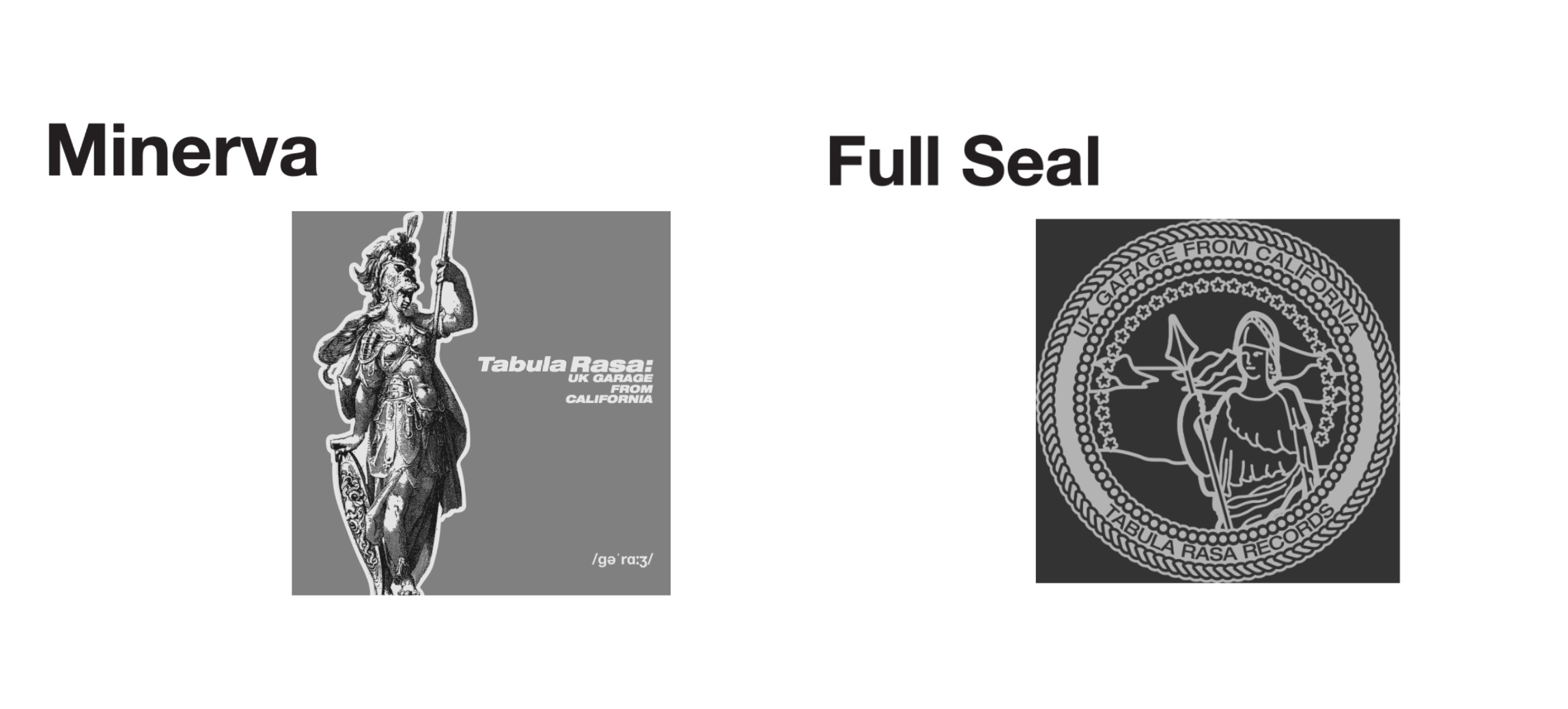
The Minerva-centric direction, for the cover itself, at least, was conceptually tight but visually overdetermined, with too much explanation in the artwork itself, and the kind of move that works in a long-form essay (thanks for reading, btw) about the project but reads as inscrutable on a streaming thumbnail. The seal became a supporting mark in the larger system instead, simplified to line art and usable at scales where the full composition couldn’t go, while the research itself sharpened how we ended up talking about the project. We were now working with these concepts of a state born already complete and a genre that arrived in California producers’ hands already articulated, ideas that had been latent in the project from the start but that the design process had pulled into focus.
Design research often works this way, in our experience. The directions you don’t use end up changing the direction you do use, not by contributing visual material but by clarifying what the work is actually about, and the value of the unused exploration is almost always invisible in the final result.
That Which Has Been Somewhere
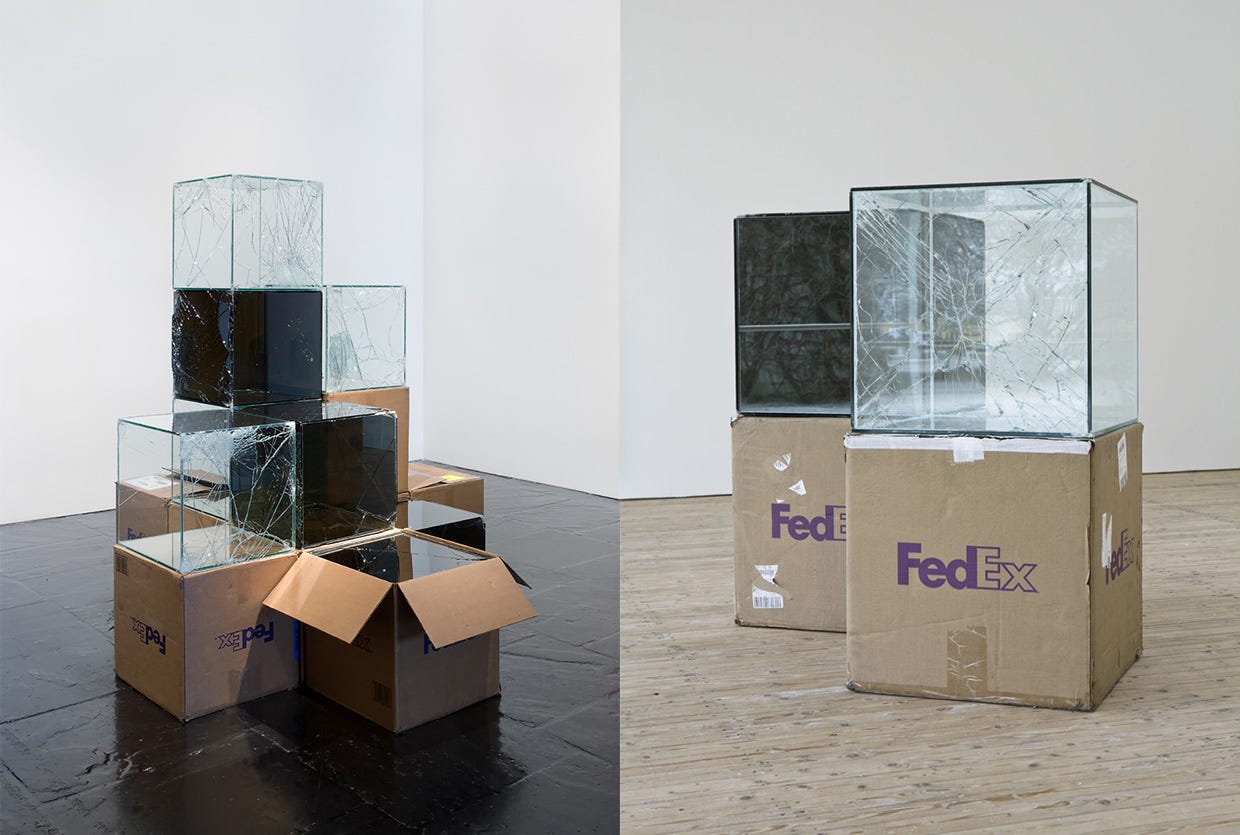
Corey had been carrying around, separately, an image of a shipped box — well-designed labels haphazardly applied, scuffed and torn in transit, arriving as an object that wears its journey on its surface. There’s a Walead Beshty project we’d both circled at different points — laminated glass boxes built to the exact internal dimensions of standard FedEx shipping boxes, sent through the network without any protective padding, the inevitable cracks and shattering becoming the work itself, the damage as record of the journey. This logic sat in the background as the typography developed, because even if the design only ever lived on screens, it needed to feel like something that had been somewhere, that had picked up marks along the way. It also seemed, the more we sat with it, like the right frame for the genre itself. UKG is, after all, an object that has been through the system — built somewhere, shipped somewhere else, accumulating “damage” and texture and unexpected fingerprints at every stop, arriving at its current location bearing very little resemblance to whatever shape it started in, and the shipping is precisely what made it the thing we now recognize. A version of UKG that had never left London, or had never been routed through the American records it was responding to, or had never been re-translated by another generation of producers somewhere else again, would not be UKG. The compilation is one more stop on that route, and the visual system needed to read as something that knew it was also in transit.
To the delight of linguistics and typography nerds everywhere alike, the phonetic spelling did most of this work in the end. /gəˈrɑːʒ/ tiled and stacked and overlapped at varying scales and opacities until the IPA characters stopped reading as legible text and started behaving as pattern — a textured field dense enough to function as its own visual surface, sparse enough to remain just barely decipherable if you decide to look closely. The California silhouette emerges from that field as a cut-out: the shape of the state, filled with the American pronunciation, containing the title of a British genre, that started as an American genre, sitting on a gradient that runs warm to cool, sunset bleeding into night, the colors of the Pacific coast around the hours where the clubs begin to fill.


What came out of the process is less a single cover image than a system of elements that can move independently across different applications. The seal works as a supporting mark while the phonetic pattern tiles across formats and the typography stands alone when it needs to. Each piece contains the project’s identity without requiring the others to be present, and the system as a whole gives the project a vocabulary rather than a logo, which is what these things actually need if they’re going to live across as many surfaces as a record now has to live across — the album cover, the singles, the streaming thumbnails, the social tiles, press materials, merch, live show backdrops, and the other half-dozen contexts that didn’t exist when we started thinking about it.
The translation onto garments was the test we hadn’t fully designed for but were pleased about when it worked. The phonetic pattern had always been meant to tile, that was always part of its function, dense enough to become texture rather than text and flexible enough to fill any shape — and when we pulled it onto sweatshirts and tees, the /gəˈrɑːʒ/ cut-out running nearly the full length of the garment, what we got was the same conceptual move the music itself made: American pronunciation worn on the body the way it sits on the artwork, all-over, insistent, unmistakable at a distance and revealing its detail up close.
The Rollout and Return
The social rollout extended the same logic in a direction we hadn’t fully planned for at the design stage but that ended up doing more conceptual work than most of what we’d planned. The premise was simple enough: we asked every contributor — every producer on the compilation, plus a number of the people in the wider orbit of the project — to send in their favorite picture of California, or of themselves in California, with no further direction. Whatever they had on their phones, and whatever they wanted the world to associate with their part of the record.
What came back was the part of the project that’s been hardest to describe afterward but that, looking at it now, is probably the part we’re most attached to. There were beach pictures and freeway pictures, late-night kitchens and morning hikes, the specific quality of light in a parking lot in Echo Park at six in the evening, somebody’s dog, somebody’s mom, a friend smoking on a balcony in the Mission, a sunset that could have been any sunset but, in context, was specifically a California one. None of the images, on their own, would tell you anything in particular about UK Garage. Taken together, posted out over the course of the rollout next to the singles and the artwork, they did something the artwork by itself couldn’t quite do: they grounded the record in the lives of the actual people who made it.


This matters more than it might initially seem, because one of the easy critiques of a project like this — a California label putting out UK Garage — is that the geography in the title could just as well be purely ornamental. That UK Garage from California is a concept rather than a fact. That the producers could be anywhere, the label could be anywhere, the record could be made anywhere, and California is just the bit of styling that gives the project its hook. But the producers weren’t ‘just anywhere’, and the label is Californian, and this record couldn’t have been made anywhere else. The record was made by people who live here. Here has weather and light and traffic patterns, and a particular set of streets and a particular set of relationships to those streets, and the music was made inside all of that, by people who have to figure out how to live in California while making it.
This is also, we think, part of what cuts against a sort of flattened and easy to levy hegemonic accusation about a larger cultural moment. Global four-on-the-floor music being everywhere is a real phenomenon, and we’ll get to that, but the texture of who is actually making it in which actual place — what their kitchen looks like, who their friends are, what they did last weekend, how the light was coming through the redwoods when they took the picture they sent us — does not flatten in the way that the genre tag flattens. The producers on this compilation are not interchangeable units in a global UKG content category. They are specifically themselves, in specifically California, making music that is specifically theirs, and the rollout was an attempt to keep that legible against the natural tendency of records to detach from their makers once they enter circulation.
The Distance
Looking at all of this from where we’re sitting now, several months on, the part of the project that’s aged best isn’t actually any of the design choices in particular, which were, after enough iteration, the correct ones — it’s the willingness to put the contradictions on the cover rather than try to design them away. A label has a choice, more or less continuously, about whether to pretend its position is uncomplicated or to admit, in the work itself, that everything it touches is already entangled with everything else, and the second option is harder to execute but tends to age better, because the first option requires a kind of innocence the listener can usually see through. We’ve talked before about labels as context — that what a label actually offers, in a feed-flattened world where music is just one more content type competing against everything else, is the work of placing things in conversation with each other, of constructing a frame the listener can use to make sense of what they’re encountering. UK Garage from California was one of the more honest pieces of that work we’ve done in this sense, because the conversation it was placing itself inside is loud and ongoing and not particularly interested in our participation, and the project’s response was to participate anyway, on the record, with the entanglement made visible rather than hidden.
There’s a larger question sitting underneath the project that the distance has also made clearer, and it’s one we’ve been turning over more since the record came out. Four-on-the-floor dance music — house, garage, the entire family of grooves that descends from that template — is, at this point, everywhere. It works in San Francisco, it works in Auckland, it works in Mexico City, it works in Chengdu, it works in Prague, it works in any number of small rooms in any number of small cities that have built the kind of scene that supports it. You can stand on a dancefloor in central Europe and hear a kick drum locking a room into the same pulse that a room in California is locked into on the same night, and the obvious uncomfortable reading of this is that it represents some kind of global hegemony machine, flattening everything, everywhere into simple, predictable interchangeable economic units, with the same musical idioms imposing itself on everyone in all corners of the world, and the unique texture of local scenes paved over by a single international corporate owned club aesthetic. There’s something to this critique, and it deserves to be taken seriously, particularly and especially by those of us running labels and writing about this stuff and helping to circulate it for a living.
But there’s also another reading here, which is the one that becomes harder to argue against when you’re actually in the room. Standing on the floor in Budapest, or in Sao Paulo, or Vienna or Goa, or Hackney or in any of these places where the music is doing what it’s doing, the case against four-on-the-floor’s globalization gets thinner the longer the set runs. The kick locks the room together, and the room locks together in a way that doesn’t feel like cultural imposition so much as cultural recognition — a shared technology of gathering, available everywhere, and used a little differently in each place. The local scenes around the music are local, the DJs are local, the crowds are local, the accents are local and the clubs are local, often deeply so, with their own histories and politics and idiosyncrasies. The pulse underneath all of it can give us a common floor to stand on. Which sounds, when you write it down, suspiciously like an apologetics for that hegemony, but on a Friday night in a basement somewhere in a city that isn’t yours, with a thousand other people deciding together to spend the coming hours moving, together, the argument doesn’t really land.
UK Garage from California sits inside of this tension, and probably contributes to it to a degree, which we’re fine with. California producers making UKG is exactly the kind of move the hegemony critique would point at — a sound traveling further from its origin, getting reproduced in a context it wasn’t made for, the global club aesthetic absorbing one more regional tradition into itself. What we have is the record we made, and the conviction that the alternative — refusing to participate, staying in our American lane, treating UKG as something we have no right to engage with — would have been worse, both as a position and as a piece of culture. Genres become provincial when they’re protected, but they live when they’re carried around, badly translated, misunderstood, recombined into things their originators wouldn’t recognize. The history of dance music is the history of that misunderstanding. The compilation is one more entry in that history, and the dancefloor pessimism that’s been the dominant register of music writing for the last few years — the dying club, the dead genre, the algorithm eating everything — is, from where we’ve been standing in actual rooms over the last six months, less true than it sounds when you read it.
The provocation, then, was always real, but so was the admiration. We didn’t think we were going to settle the question of who owns the genre, and we definitely weren’t trying to. We were trying to add to it, in a way that took the question seriously without taking ourselves so seriously that we couldn’t make the joke at the center of the project. From where things are now, with the artwork showing up on bodies at parties we didn’t book and the singles cycling through sets we haven’t heard, the project seems to have done everything we hoped for, and much more — which is to say, it left the building it was made in, went somewhere we couldn’t follow, and turned into something we no longer entirely control, which is, of course, the whole point.
UK Garage from California is still available everywhere.
Also, listen to Nathan Evans and RamonPang chat about UKG from CA on RinseFM UK
Merch, for UKG from California is available from our webshop.
Concept & Direction: Jozef White, Corey McShane
Design: Corey McShane
The Tabula Rasa Record Company