

Stained with Light
Ritual, Residue, and Release

The Wine Glass
It starts with water in a wine glass. Arun spins it gently and records the resonance on his phone while doing dishes — a moment that most people would not register, let alone preserve, but this is entirely the point. There’s no plugin that could replicate this moment, nor an Ableton preset with a name like “ritual glass swirl.” It is a small but weighty act of intentionally directed attention that leaves a trace, a mark, a stain, if you will.
The anecdote above comes from the opening pages of Arun Dhanjal’s companion book to his recent EP, ‘Light Stain at Dawn,’ and feels like a door into a different way of listening. A mode of listening where music is experienced like incense curling up into smoke, filling a room slowly with its essence, its residue, and a sense that what stains us might save us. The EP emerged from the CDR Pathways program, which is a talent development initiative that provided funding, mentorship, and resources. After 2023’s successes with Practice Makes Miracles, Unfurl (on Tabula Rasa), Karma Sheen, and Warehouse Project, 2024 felt like starting over.
The title, ‘Light Stain at Dawn,’ comes from a poem by Mary Oliver: “I have wrestled with the angel and I am stained with light.” The record touches and changes but doesn’t wipe anything clean. Simone Weil said that attention, properly applied, is prayer. The stain is evidence that presence occurred.


What Does It Mean to Be Zar?
Zar, the word, the concept, is a ghost and a placeholder. A memory from a neuroscience lecture. Arun saw the word in a cognitive neuroscience class at King’s College, where it floated on a syllabus sheet and embedded itself in his subconscious because of its resonance. Years later, it resurfaced as a name for making music.
Zar also refers to rituals of spirit possession and reconciliation practiced mostly in Egypt where sonic systems are built on trance through rhythm, healing through embodiment. Arun’s work brushes against these traditions in spirit, intentionally and unintentionally. With time, the name grows heavier.
He encountered the word Zar in that neuroscience class, the concept of these possession rituals and it stayed with him for its resonance, its sound. Years later, when he needed a name for making music, it resurfaced. Using it shifted something. What started as an academic encounter became personal and carried weight differently. In the companion book, he asks himself whether there is cultural borrowing or intuitive alignment happening, but doesn’t settle it. His work doesn’t use elements of Zar music and he’s clear about that boundary, but the name persists because something about it still feels right, even knowing what it carries. The book acknowledges this tension without resolving it.
Somatic Sequence
The record moves through five precise phases. Track one (”You’re It”): energy arising from the ether. Track two (”Slip”): manifestation as discomfort, melancholy. Track three (”Deph”): resistance, wanting to escape. Track four (”Light Stain at Dawn”): clarity and acceptance. Track five (”Peace to All Mankind”): lessons learned, peace achieved. The phases map loosely to therapy process and to Vipassana meditation, lived and emergent rather than planned.


“You’re It” opens the sequence, setting the energetic foundation. Then, track two, “Slip”begins the bulk of the record’s emotional journey. Originally 11 minutes in demo form, “Slip” was influenced by Leon Vynehall’s “Sugar Slip (The Lick)” and weaves two ragas through its structure: Bageshree and Mian Ki Malhar. The track became a collaboration when Sameer Khan from Karma Sheen added harmonium, bansuri, and acoustic guitar. The recording process itself embodied the EP’s philosophy of embracing imperfection: the harmonium had to be pitch-shifted down an octave to restore the missing low end, while the bansuri was literally gaff-taped to play in the right key. Everything captured through that not-ideal AT2040 podcast microphone, the flaws becoming features.
“Deph” transforms the energy completely. Built entirely from samples — specifically Hainbach’s vintage synth packs — influenced by Pangaea’s “Changing Channels,” the track moves through three distinct movements. Even the bassline speaks to this sample-based construction: it’s actually a detuned bongo, repurposed and transformed.
The title track “Light Stain at Dawn” arrived through what Arun describes as near-possession. After setting an intention the night before, he woke charged with an unusual calm and peace, feeling pushed along by some force, almost on autopilot. The track incorporates that wine glass whooshing he’d recorded on his phone while doing dishes, bass guitar harmonics inspired by Colour Haze’s “Tempel,” and takes its name from the Mary Oliver poem he’d seen on Instagram.
“Peace to All Mankind” closes the arc with influences from Four Tet’s “Pinnacles,” using Korg ELECTRIBE-R plugin for drums and a bass line influenced by The Isley Brothers. The track incorporates samples from “Art of Primitive Sound - Musical Instruments From Prehistory - The Paleolithic” and ends with algorithmic noise from the Destiny plus website — a final gesture toward randomness and resolution.
Three tracks feature a live string quartet recorded at Sounds Like These studios, where Charlie Shrives engineered the session with seven microphones: Neumann KM86i, Coles 4038’s, Rode NT5’s, and AKG C414 XLS. Tony Nwachukwu contributed additional production and mixing at The Old Stationary Building, while Adam Scrimshire from Albert’s Favourites handled the mastering. Rosh Chauhan from Works of Intent provided mixing fundamentals lessons that helped shape the entire production approach.


In his book, Arun writes from a place of fatigue and illumination. Therapy unearthed things like panic attacks, muscle tightness and sciatica while music became the residue — the remaining shape of a processed state.
During the making of LSAD, Arun kept notebooks. In one entry from Riga, he wrote: “strong journey, completion of emotions through a cycle.” At the time, he was just documenting what he was feeling. Only later did he realize he’d mapped the arc of the entire record without knowing it — piecing together parts of a jigsaw puzzle where you already know the answer but forgot, the same lessons in different form. Rediscovery.
The record reshapes emotional expectations by refusing easy cues. Discomfort stretches, transforms, resolves, without telegraphing directly to the listener. The body remembers before the mind catches up.
Beneath every track runs the sonic bed: tape hiss, sea recordings from Lyme Regis, cricket sounds. This continuous thread ties the phases together, makes the EP breathe as one organism.
Your Plan Assumes Everything Stays the Same
Arun recalls a yellow square Elijah once posted on Instagram with text: Your plan assumes everything stays the same. Arun returns to it often. Everything does change from the body, to the process, to one’s sense of worth.
The post-release haze is real, too. Releasing a record like this probably should feel like release. Instead, tension emerges. Will people “get it”? Will they reduce it? Stream one track and move on? Mishear the arc? Or worse, will they ignore it completely?
Arun knew LSAD couldn’t be chopped up neatly into campaign assets. So he wrote a book to protect the record, and the book became its own ritual — a final gesture of fidelity. Written between January - March 2025, he describes it as “unnecessary, unmarketable, unstrategic, true.”
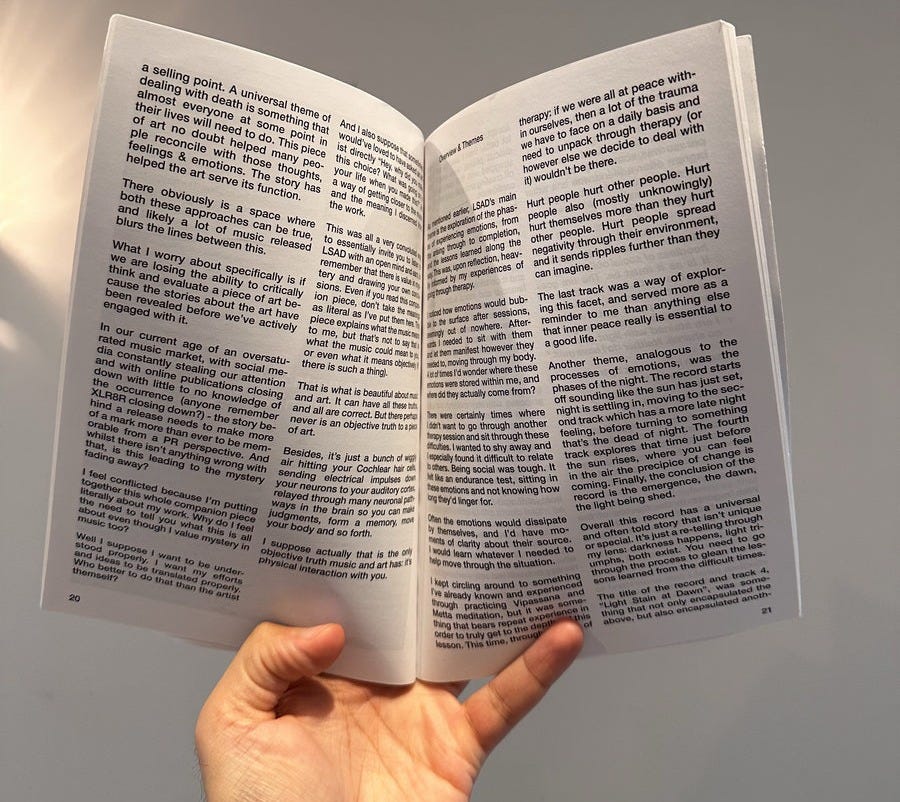
Finishing it brought relief — the kind that comes when a process actually completes. The record was done. The book closed the circle. A way to remember it all, to put it in writing because it felt special — closure that the release itself couldn’t provide.
We live in a time where everything must be narrated to exist, and narration erodes mystery. Even symbolic work gets decoded into personality. Art feels thin.
The book is absurd in the best way: making meaning when the gesture itself seems pointless.
Clean Feelings, Dirty Truths
What tech culture calls polish, this record refuses. You won’t find any AI-automated mixing or tempo grid discipline here. The harmonium is slightly out of tune and the bansuri was gaff-taped to play the right key. The microphone wasn’t ideal and the sessions were chaotic. Keys clicking, breathing and the room, every element audible.
In the book, Arun describes duplicating the harmonium take, pitch-shifting it an octave down to fix the low end. Reinforce what’s already there rather than faking clarity.
The cover art too — Natasha Patel’s spontaneous photoshoot with a plant pot and ring light — was an accident. She placed it on the couch, fabrics underneath, playing with light. It became the metaphor without anyone planning for it to.

Arun’s a drummer, which means that the most physical of instruments, sets a baseline for what feels real. In an ever-digital world, he finds himself resisting the push forward sometimes, searching for balance. The harmonium, the plant pot, the dawn light, the live instruments — all felt realer than their digital equivalents.
The project echoes Kintsugi, the Japanese practice of mending broken ceramics with gold. The flaw becomes part of the form, transformed from weakness into beauty.
Music as Ritual
“Music is a way to be possessed on your own terms.”
Possession, in the Zar sense, is temporary and healing — a cohabitation. Something visits, is danced with, and then leaves.
Rituals are buried in the record: the sonic bed that recurs across tracks, the conscious avoidance of fixed tempo, the refusal to resolve too quickly. Music structured like a session with an entrance, movement, exploration, and where you exit changed.
The club too, becomes part of this — informal ritual space where repetition suspends narrative and presence becomes escape, a place where we reconcile through movement.
Light Stain at Dawn gives ritual without religion’s baggage. Repetition as recovery rather than recurrence. A return that brings something back.
The cycle closed quickly. Too quickly, maybe. Arun lives for those moments of pushing through to something, and he wants to be in that space again, but life doesn’t feel like that now. He can’t force it. Has to wait for something to strike. In the meantime, he keeps making music.
He sees the record as a narrative snapshot of that time, that story, and hopes one day he can listen again and learn something new — or learn something he already knew but needed to hear again. The stain remains, even after the light shifts.
Recorded music now gets chewed up, has its flavor extracted, and is quickly discarded. Platforms need clean metadata, discrete tracks and reproducible engagement patterns. Everything has to be separable, skippable, playlist-able.
Some things only work as wholes, where the arc is the point. You can’t chop up a therapy session into highlights or stream a ritual with ad breaks. These things need time between entrance and exit. They need you to actually be there for what happens in between.
Arun wrote this book to protect a record from being misunderstood. When work requires presence, actual attention, it becomes illegible to the systems designed to measure engagement. It leaves residue, and the wine glass resonance, the gaff-taped bansuri, the harmonium an octave down is all evidence that someone was actually there, that the process was real, that the flaw is load-bearing. The culture wants this smoothed out, seamless, with the labor invisible. But the labor is the thing.
Making work in the gap between what platforms measure and what actually matters: the book you write to close the circle, the decision to refuse legibility, the choice to let things stay broken in the right places.
Arun’s waiting for something to strike again. In the meantime, he’s making music. The record exists. The book exists. Whether anyone gets it or reduces it or ignores are all things that happen outside of the room where the work happened.
A physical copy of the companion book can be found here, along with a digital version, here. Be sure to check out the EP, as well, here and connect with Zar here.